
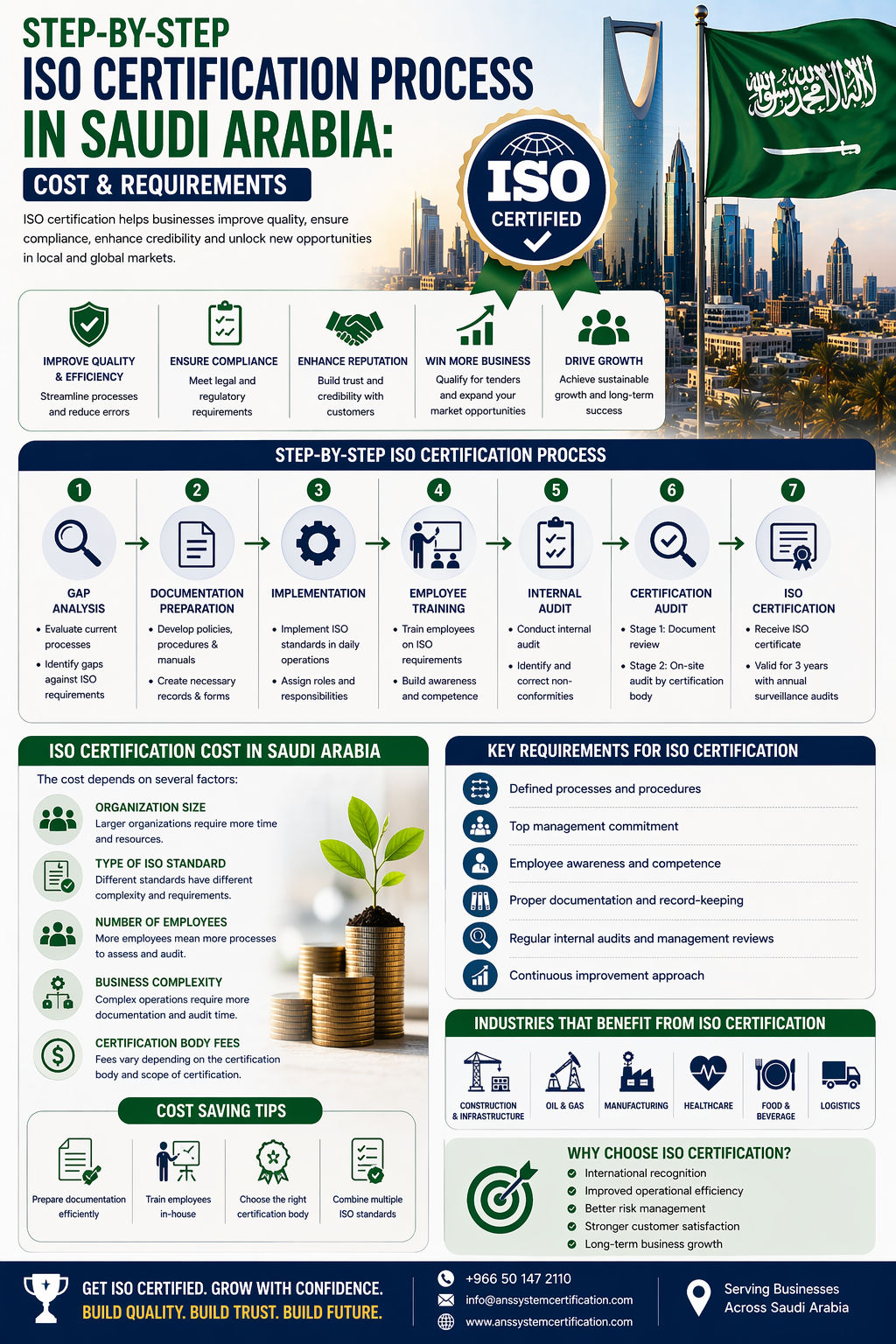
Step-by-Step ISO Certification Process in Saudi Arabia: Cost & Requirements
In today’s competitive business environment, achieving international standards is essential for growth, credibility, and compliance. One of the most effective ways to ensure this is through ISO Certification in Saudi Arabia. Whether you are a startup or an established enterprise, understanding the certification process, cost, and requirements can help you achieve ISO certification smoothly and efficiently.
This detailed guide explains the step-by-step process, cost factors, and key requirements for obtaining ISO certification in Saudi Arabia.
What is ISO Certification?
ISO (International Organization for Standardization) certification is a globally recognized standard that ensures organizations meet international benchmarks for quality, safety, efficiency, and environmental responsibility.
Some popular ISO standards include:
- ISO 9001 – Quality Management System
- ISO 14001 – Environmental Management
- ISO 45001 – Occupational Health and Safety
- ISO 22000 – Food Safety Management
For businesses in the Kingdom, ISO Certification in Saudi Arabia enhances credibility and helps meet regulatory and customer expectations.
Why ISO Certification is Important in Saudi Arabia
Saudi Arabia’s Vision 2030 initiative is driving rapid economic growth and global integration. As a result, ISO Certification in Saudi Arabia has become essential for businesses aiming to stay competitive.
Key benefits include:
- Improved business efficiency
- Compliance with local and international regulations
- Enhanced brand reputation
- Increased customer trust
- Eligibility for government and private tenders
ISO certification is no longer optional—it is a strategic requirement for business success.
Step-by-Step ISO Certification Process
Understanding the certification process helps businesses plan effectively and avoid delays.
1. Gap Analysis
The first step in the ISO Certification in Saudi Arabia process is gap analysis. This involves evaluating your current systems and identifying gaps compared to ISO requirements.
Purpose:
- Understand current performance
- Identify areas for improvement
- Create an action plan
2. Documentation Preparation
Documentation is a crucial part of ISO certification. Businesses need to prepare:
- Policies and procedures
- Work instructions
- Records and manuals
Proper documentation ensures consistency and compliance with ISO standards.
3. Implementation
Once documentation is ready, the next step is implementing ISO standards across the organization.
Key activities:
- Align processes with ISO requirements
- Assign roles and responsibilities
- Integrate systems into daily operations
Effective implementation ensures that ISO standards are followed in practice.
4. Employee Training
Training employees is essential for successful ISO implementation.
Benefits of training:
- Improves awareness of ISO standards
- Ensures proper execution of processes
- Reduces errors and non-compliance
Employees play a key role in maintaining ISO standards.
5. Internal Audit
Before the final certification audit, organizations must conduct an internal audit.
Purpose:
- Identify non-conformities
- Correct issues
- Ensure readiness for external audit
Internal audits help improve system effectiveness and compliance.
6. Certification Audit
An accredited certification body conducts the final audit.
Audit stages:
- Stage 1: Review of documentation
- Stage 2: Evaluation of implementation
If the organization meets all requirements, certification is approved.
7. ISO Certification
After successfully passing the audit, the organization receives ISO certification.
Validity:
- Typically valid for 3 years
- Requires annual surveillance audits
Achieving ISO Certification in Saudi Arabia demonstrates commitment to quality and excellence.
ISO Certification Cost in Saudi Arabia
The cost of ISO Certification in Saudi Arabia varies depending on several factors:
1. Organization Size
Larger companies require more extensive audits and documentation.
2. Type of ISO Standard
Different standards have different requirements and complexity levels.
3. Number of Employees
More employees mean more processes to evaluate.
4. Business Complexity
Industries with complex operations may require additional effort.
5. Certification Body Fees
Costs vary based on the certification provider.
How to Reduce ISO Certification Costs
Businesses can manage costs effectively by:
- Preparing documentation internally
- Training employees in-house
- Choosing cost-effective certification services
- Combining multiple ISO certifications
A well-planned approach helps achieve certification without overspending.
Key Requirements for ISO Certification
To obtain ISO Certification in Saudi Arabia, organizations must meet certain requirements:
- Defined processes and procedures
- Strong management involvement
- Employee awareness and training
- Proper documentation and record-keeping
- Regular internal audits
- Continuous improvement practices
Meeting these requirements ensures smooth certification and long-term compliance.
Industries That Require ISO Certification
ISO certification is widely used across industries in Saudi Arabia, including:
- Construction and Infrastructure
- Oil and Gas
- Manufacturing
- Healthcare
- Food and Beverage
- Logistics and Supply Chain
Many of these industries require ISO certification to qualify for projects and contracts.
Common Challenges in ISO Certification
Businesses may face some challenges during the certification process:
- Lack of knowledge about ISO standards
- Resistance to change
- Time constraints
- Complex documentation
These challenges can be overcome with proper planning and structured implementation.
Tips for Successful ISO Certification
To ensure success, businesses should:
- Involve top management
- Train employees regularly
- Maintain accurate documentation
- Conduct internal audits
- Focus on continuous improvement
A proactive approach ensures long-term benefits from ISO certification.
Future of ISO Certification in Saudi Arabia
With ongoing economic transformation and globalization, the demand for ISO Certification in Saudi Arabia is increasing rapidly. Businesses are adopting ISO standards to improve efficiency, quality, and competitiveness.
ISO certification will continue to play a vital role in supporting Saudi Arabia’s Vision 2030 goals.
Conclusion
Achieving ISO Certification in Saudi Arabia is a structured process that requires planning, commitment, and proper implementation. From gap analysis to certification audit, each step plays a crucial role in ensuring compliance with international standards.
Understanding the cost and requirements helps businesses prepare effectively and avoid unnecessary delays. ISO certification not only improves operational efficiency but also enhances credibility, customer trust, and business opportunities.
Investing in ISO certification is a smart decision for organizations looking to grow and succeed in Saudi Arabia’s competitive market.