
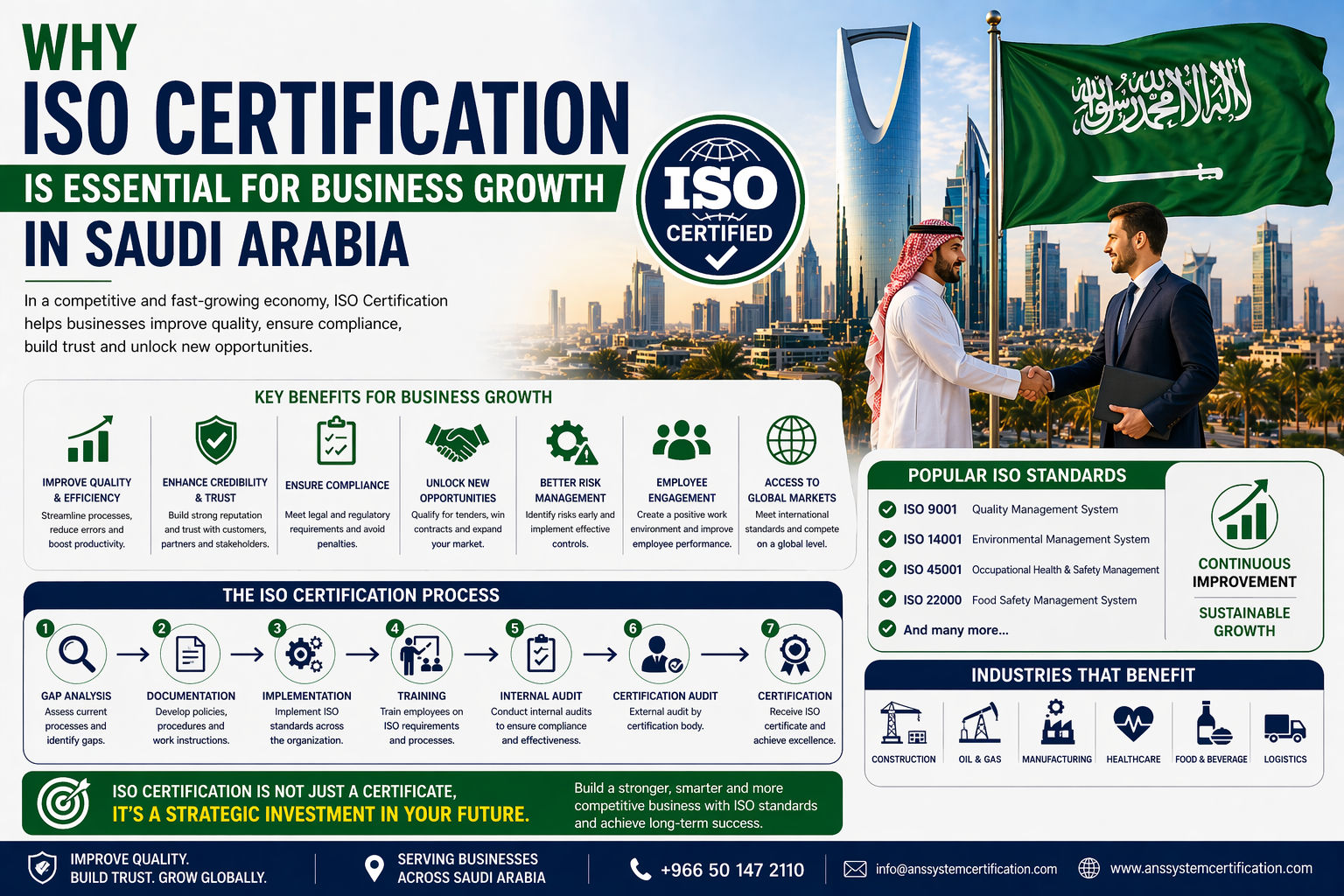
Why ISO Certification is Essential for Business Growth in Saudi Arabia
In today’s competitive and rapidly evolving business environment, organizations must continuously improve their processes, maintain quality standards, and ensure compliance with regulations. One of the most effective ways to achieve these goals is through ISO certification. For companies operating in the Kingdom, ISO Certification in Saudi Arabia has become a key driver of growth, credibility, and long-term success.
This blog explores why ISO certification is essential for business growth and how it helps organizations thrive in Saudi Arabia’s dynamic market.
What is ISO Certification?
ISO (International Organization for Standardization) certification is a globally recognized standard that ensures businesses operate efficiently, safely, and consistently. It provides a structured framework for managing processes and improving performance.
Some widely used ISO standards include:
- ISO 9001 – Quality Management System
- ISO 14001 – Environmental Management
- ISO 45001 – Occupational Health and Safety
- ISO 22000 – Food Safety Management
By implementing these standards, businesses demonstrate their commitment to quality, safety, and continuous improvement.
Growing Importance of ISO Certification in Saudi Arabia
Saudi Arabia is undergoing significant transformation under Vision 2030, focusing on economic diversification, infrastructure development, and global competitiveness. As a result, ISO Certification in Saudi Arabia is becoming increasingly important for businesses across all sectors.
Organizations are adopting ISO standards to align with international best practices, meet regulatory requirements, and enhance their market position. Whether in construction, oil and gas, healthcare, or manufacturing, ISO certification is now a critical factor for success.
Key Benefits of ISO Certification for Business Growth
ISO certification offers numerous advantages that directly contribute to business growth.
1. Improved Quality and Efficiency
ISO standards help organizations streamline their processes, reduce errors, and improve efficiency. For example, ISO 9001 focuses on quality management, ensuring consistent product and service delivery.
By implementing ISO Certification in Saudi Arabia, businesses can:
- Standardize operations
- Reduce waste and inefficiencies
- Improve overall productivity
This leads to better customer satisfaction and long-term growth.
2. Enhanced Credibility and Brand Reputation
ISO certification is recognized worldwide as a mark of quality and reliability. It enhances your company’s reputation and builds trust with customers, partners, and stakeholders.
In Saudi Arabia, having ISO Certification in Saudi Arabia gives businesses a competitive edge, especially when dealing with international clients or entering global markets.
3. Compliance with Regulations
Saudi Arabia has strict regulations across various industries to ensure safety, quality, and environmental protection. ISO certification helps businesses comply with these requirements effectively.
By following ISO standards, organizations can:
- Meet legal and regulatory obligations
- Avoid penalties and legal issues
- Maintain a strong compliance record
This is particularly important for industries like construction, oil and gas, and healthcare.
4. Increased Business Opportunities
Many government and private tenders in Saudi Arabia require ISO certification as a mandatory qualification. Without it, businesses may miss out on valuable opportunities.
With ISO Certification in Saudi Arabia, companies can:
- Participate in large-scale projects
- Win contracts and tenders
- Expand their customer base
This directly contributes to business growth and revenue generation.
5. Better Risk Management
ISO standards emphasize risk-based thinking, helping organizations identify and manage potential risks proactively.
For example:
- ISO 45001 focuses on workplace safety
- ISO 14001 addresses environmental risks
Implementing these standards reduces accidents, improves safety, and minimizes operational risks.
6. Improved Employee Engagement
ISO certification promotes a structured work environment where roles and responsibilities are clearly defined. It also encourages employee involvement in continuous improvement processes.
Benefits include:
- Higher employee satisfaction
- Better teamwork and communication
- Increased productivity
A motivated workforce plays a vital role in achieving business growth.
7. Global Market Access
ISO certification is recognized internationally, making it easier for businesses to expand beyond local markets.
With ISO Certification in Saudi Arabia, companies can:
- Enter global markets
- Build international partnerships
- Compete with global brands
This opens up new opportunities for growth and expansion.
ISO Certification Process in Saudi Arabia
Understanding the certification process helps businesses implement ISO standards effectively.
1. Gap Analysis
Identify gaps between current practices and ISO requirements.
2. Documentation
Prepare policies, procedures, and manuals.
3. Implementation
Apply ISO standards across the organization.
4. Training
Educate employees about ISO requirements.
5. Internal Audit
Ensure compliance before external audit.
6. Certification Audit
An external body evaluates the system.
7. Certification
Receive ISO certificate upon successful audit.
Following a structured approach ensures a smooth certification process.
Industries Benefiting from ISO Certification
ISO certification is valuable across various industries in Saudi Arabia, including:
- Construction and Infrastructure
- Oil and Gas
- Manufacturing
- Healthcare
- Food and Beverage
- Logistics and Supply Chain
In many of these sectors, ISO certification is essential for participating in major projects and maintaining compliance.
Challenges in ISO Certification
While ISO certification offers significant benefits, businesses may face some challenges:
- Lack of awareness about ISO standards
- Resistance to change within the organization
- Complex documentation requirements
- Time and resource constraints
However, these challenges can be overcome with proper planning and structured implementation.
Tips for Successful ISO Implementation
To maximize the benefits of ISO certification, businesses should:
- Ensure strong leadership involvement
- Provide regular employee training
- Maintain accurate documentation
- Conduct internal audits regularly
- Focus on continuous improvement
A proactive approach ensures long-term success and sustainability.
Future of ISO Certification in Saudi Arabia
With ongoing economic transformation and globalization, the demand for ISO Certification in Saudi Arabia is expected to grow rapidly. Businesses are increasingly adopting ISO standards to improve quality, safety, and efficiency.
As Saudi Arabia continues to develop under Vision 2030, ISO certification will play a crucial role in shaping a competitive and sustainable business environment.
Conclusion
ISO certification is more than just a formal requirement—it is a powerful tool for business growth and success. By implementing ISO Certification in Saudi Arabia, organizations can improve quality, ensure compliance, and build a strong reputation in the market.
From enhancing operational efficiency to unlocking new business opportunities, ISO certification provides a solid foundation for sustainable growth. Whether you are a small business or a large enterprise, investing in ISO standards is a strategic decision that will benefit your organization in the long run.
Now is the right time to adopt ISO certification and position your business for success in Saudi Arabia’s competitive and evolving market.